Wednesday, April 24, 2013

Guest Post! North Korea

Hey everyone. My name is Faith Savaiano, and I'm very excited to be doing a guest blog for Brian. I'm one of Brian's classmates, and he's always been jealous of me because of how much better at history I am than him. Just kidding...

Anyways, Brian talks a bit about repeating history and learning from those repetitions. Or not. This is quite apparent recently in the U.S.'s (and everyone else's) ongoing tensions with North Korea. Many people are quite frankly freaked out by North Korea's recent actions, while others find it mildly amusing.

There are, indeed, historical reasons to back up both of these reactions:

ALARM - The main reason for alarm is the man, or boy, calling the shots, Kim Jong-Un. Not only is he young and impulsive, but because of North Korea's veil of secrecy, no one really knows who he is. So when he threatens to hit South Korea or mainland USA with a preemptive nuclear strike, it's hard to know how long we can call his bluff. Kim Jong-Un is a man without a clear history, and that makes him scary.

AMUSEMENT - On the other hand, North Korea has a long history of making idle threats against the U.S. and others. Since the end of the Korean War in 1953, relations have been less than friendly between North Korea and the U.S., so we've exchanged our fair share of empty threats on both sides. Also, the complete control North Korea has over it's media often results in humorous publications, such as a 2011 Global Happiness Index, conducted by North Korea, which ranked China as the happiest country in the world, followed closely by North Korea in second (got to appreciate that modesty). "The American Empire" ranked a sad last on the list.

Tuesday, April 2, 2013

New Historicism

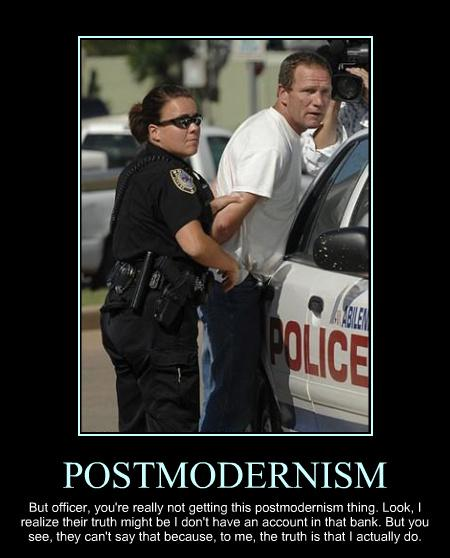
New Historicism is an interesting combination of literature and history.  And when I say that it's a combination of literature and history, I mean that it looks at literature to examine history.  It's a very postmodern idea, and is one of the few aspects of postmodernism that I actually can understand.

"Postmodern" is like "hipster".  By now, neither word means anything.
Fun fact: Calling something "Postmodern" is a great way to look intellectual without actually knowing anything.
Back on topic, New Historicists believe that classical works can't be examined through modern viewpoints, because those viewpoints are modern constructions.  Because they didn't exist when the piece was written, we can't apply them to the work.  Also, they believe that any analysis or criticism of a piece of literature will tell you more about the time in which the analysis criticism was written than anything about the actual literature.

So how do New Historicists look at literature?  They get back into the mind-frame of the time.  Think a character has a mental illness?  Then you've got to think about it in terms of the mental health treatment of that period, even if it seems insane now.  They can use concurrent literature as sources (with a broad definition of "literature" meaning anything that was written, including records), but works from other times are out.

Tuesday, February 26, 2013

Missing History


Despite what your US history textbooks may have tried to tell you, we will never have a complete understanding of history.  History is essentially one infinitely long game of telephone: things get corrupted and then accepted as fact, some parts drop out, some parts get added.  The view of history changes so often that there's a whole field dedicated to just studying views on history.

The reason that people are able to study how our view of history has changed (and a major part of studying history itself) is books.  Books are able to keep records of knowledge for thousands of years, passing their wisdom onto future generations.
Our wisdom for future generations.
Which is why it's such a shame when books, especially famous and important books, get lost.  The worst example of this is the destruction of the Library of Alexandria.  At the time, the Library was the single largest collection of knowledge anywhere in the world.  It was originally ordered by Alexander the Great, who wanted a collection of his empire's knowledge.  Although he never lived to see its completion, his dream lived on.

For a while, anyway. Like the lighthouse before it, the library proved that nothing famous in Alexandria can stay forever.  Amazingly, no one even knows who destroyed the library.  Suspects have ranged from Julius Caesar to Theophilus, a Patriarch of Alexandria, to Caliph Omar.  What is known, however, is that very few of the works held in the library survived.

The loss of the Library of Alexandria is possibly the reason that there are holes in every World History textbook.  No one really knows exactly what was lost with the library, but there is no doubt that invaluable historical texts were destroyed.  If the library still stood, who knows what we would have access to?

Tuesday, January 29, 2013

Conspiracy Theories

I love conspiracy theories.  They are the alternate history (or present) that usually make my craziest ideas seem pretty sane by comparison.  But while almost all conspiracy theories sound pretty crazy, that doesn't mean that they're all wrong.  In fact, some of the craziest sounding conspiracy theories wound up being right on the money.  These theories turned out to be things like:

Operation Snow White

You may have heard of Scientology, the religion that was founded by a Science Fiction writer and has had some issues with public relations in the past, both recent and not so recent.  So in the 1970's the Church of Scientology decided to go with the basic reaction of any group with a bad public image: they infiltrated the government to get rid of any records that portrayed them in an unfavorable light.

Over the course of about 2 years, the Church of Scientology had as many as 5,000 covert agents infiltrate various branches of the government, including the IRS, the Coast Guard, and the DEA.  The main goals were to gain a tax-exempt status as a religious group and to remove any evidence of Scientology's crazier plots (including when they tried to get a journalist committed to a mental institution).

Amazingly, the plan worked.  Then, in early 1977, one of the agents got arrested while breaking into a government building.  After that, it all unraveled very quickly, culminating in 11 high-ranking members, including the founder's wife, getting indicted in 1978.  6 of the 11 went to jail for four years, and each had to pay a $10,000 fine.

I would call that pretty light punishment for the people who orchestrated the single largest infiltration of the government in the history of the United States.

Government Media Control

Everyone has heard at one time or another the theory that the government actually controls everything that we see and hear in the media.  Most of the time, the people that you hear it from are also convinced that a secret organization actually rules the world, so I wouldn't put too much stock in the theory itself.

Then again, reality can be a strange thing.  In 1948 Frank Wisner, who was in charge of the sinister-named Office of Special Projects, started Operation Mockingbird.  This goal of this operation was to infiltrate every major media outlet with reporters who were on his payroll.

The program was astonishingly successful.  In under ten years, there were over 400 reporters on the government's payroll, including some of the big shots at ABC, NBC, CBS, The New York Times, and the Associated Press.  This level of infiltration allowed the government to suppress any story they didn't like as well as planting pro-government stories.  Apparently, this was all so easy because, as one operative noted, "You could get a journalist cheaper than a good call girl, for a couple hundred dollars a month."

Luckily for us, the entire operation was disbanded in the mid-1970's.  Or not, according to much of the internet.


--------
For this post, much of my research and some of my sources came from Cracked.com, who I strongly recommend that you check out, especially this article:

Wednesday, January 9, 2013

Interesting History: Troy


Troy is an ancient city made famous first by Homer in the Iliad (c. 1250 BC) and then by Brad Pitt in the film Troy (c. 2004).  It is best known as the namer of the Trojan Horse and the site of the Trojan War, which serves as something of a prequel for The Odyssey, making it the bane of high school students everywhere.  The city itself was thought to be mythical for a while, on account of how no one could find it.  And that's where the story gets interesting.

The man who actually discovered Troy was Heinrich Schliemann, a German archaeologist.  When he got to the site, he discovered that there were actually ruins of at least nine ancient cities, all stacked on top of each other.  This was fairly common practice in ancient times, because if somewhere was good enough to live (and like Troy, right on a lucrative trade route), there was no reason to let a few ruins get in your way.  You just built right on top of them.

When Schliemann saw this, he figured that since the Troy of the Trojan war was from Grecian times, it had to be on the bottom.  So he went right to blasting.  He went all the way down to the bottom level, where he claimed that he had discovered Troy and King Priam's treasure.  The only problem was that this left about a thousand-year gap in Troy's history.  But screw that, he found treasure!
See, treasure!

People just accepted this for about 20 years, until another archaeologist found that one of the other cities in the pile matched up with Homer's description much better.  A city five freaking levels above where Schliemann had claimed Troy was and almost 2,000 years younger.  So in his fervor to find Troy, Schliemann had actually blown straight through it, and did such a good job of it that archaeologists are still complaining about how much he destroyed to this day.

Wednesday, December 12, 2012

For those of you who haven't heard of We Didn't Start the Fire by Billy Joel, it is a song about history.  More specifically, it outlines every major event (and several boxing matches) in American history from about 1949-1990 in chronological order.  It's actually extensive enough that a book of American history used the song as a guide for what to talk about for the period from 1949-1990.  It also has a fairly famous video.


What's almost amazing as the depth of the song itself is the sheer number of adaptions and parodies made to the tune (scroll down a little on the linked page for the list).  Some of them have just used the (admittedly catchy) tune, but others have continued to use the history theme, and some of them have been fairly impressive.  Here's a list of the three most impressive random histories I've seen set to Billy Joel.


Singapore (a.k.a "I Live in Singapura")


This song is the epitome of a random history.  I didn't know anything about Singaporean history until this video, but this song and video were hilarious anyway.  And while the song is still funny even in a vacuum, a little context can go a long way in making the video even better.

Political Scandals (a.k.a "We Didn't Start Satire")


This one is a pure song.  The video helps with some context, but the song is the real humor here.  It outlines almost every political scandal in Washington (and some in other states as well) starting in 1981.  This was written for the 30th year of Capitol Steps, a satire group from DC, and their knowledge shows.

Video Games (a.k.a "The Wii Didn't Start the Fire")


This is definitely my favorite song and video on the list.  These guys did a great job with the lyrics (which cover the history of video games from their beginning until about 2010), the sound effects (they frequently use sound clips from the things they're referencing, which are awesome if you recognize them), and the video (which uses video clips from virtually everything they mention).  They even kept the video in a similar style to Billy Joel.

Wednesday, December 5, 2012

The Iran Trap

Recently, I've been reading The Bottom Billion by Paul Collier for my history class.  It's a fairly interesting book that describes why the poorest countries (which account for approximately 1 billion people, hence the title) seem to be so far behind the rest of the world.  Collier describes four "traps" that these countries seem to fall into.  The traps are:

The Conflict Trap

This one is about civil wars and coups.  Both end up costing the countries billions of dollars, and in the few years after a civil war or coup the country is more likely to have another.  Collier also argues that the longer a country stays trapped in civil war, the more people are likely to profit from it and the increased interest in keeping the civil war going.

The Natural Resources Trap

This trap is counterintuitive.  Collier states that poor countries that suddenly gain abundant natural resources will likely be worse off than before for three reasons:
1) More resources means that conflict over those resources is more likely.
2) The more money the government can make off of the resources, the less they need to tax the citizens, which leads to a lack of financial accountability.
3) Dutch Disease

Landlocked with Bad Neighbors

Countries with access to the sea have access to the world.  Landlocked countries have access to their neighbors.  If a country is landlocked and their neighbors are unfriendly or in a state of turmoil, the country suffers.

Bad Governance in a Small Country

A bad government can destroy an economy very quickly.  So in a small country, where countries are already wary of investing because of the smaller workforce, bad governance can doom any prospect of foreign investment.

So now that that's out of the way, let's see how the traps apply to a country that's been in the news a lot recently: Iran.  In order:

1) Iran isn't caught in the conflict trap.  This isn't surprising when you think about the state of Iran now, but it is impressive that Iran avoided the trap 30 years ago.  They were able to avoid falling into a state of constant warfare by having a brutal regime that essentially exterminated all competition.

2) Iran also avoided the natural resources trap, despite having great oil reserves.  Part of the reason is that oil was discovered decades ago, which gave Iran time to build structure around the industry.  Another part of the reason is that the oil was discovered by the British, who had experience in the oil industry.  These factors combined to give Iran a stable oil business.

3) Iran's not landlocked.  Simple as that.

4) Iran also isn't a small country, and because the oil industry is so strong, all the government has to do is stay out of the way and then they can dive into their money pools like Scrooge McDuck.